
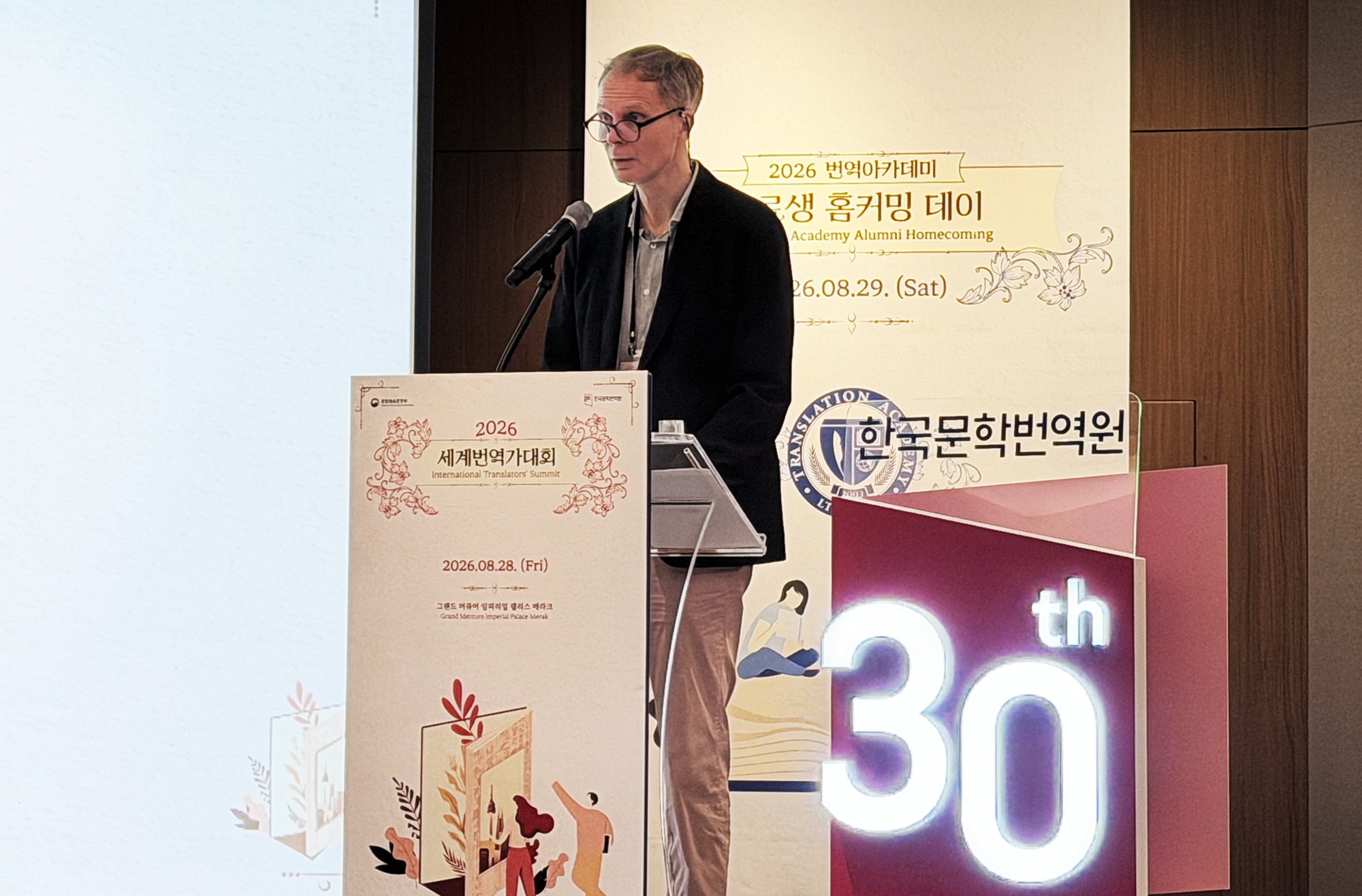
Anders Karlsson, a professor of Korean studies at the School of Oriental and African Studies (SOAS) at the University of London, on Aug. 28 gives a keynote speech at this year’s International Translators’ Summit at the hotel Grand Mercure Imperial Palace Seoul in the capital’s Gangnam-gu District. (Xu Aiying)
By Xu Aiying
A recent international conference in Seoul looked back on three decades of achievements in the translation of Korean literature and explored the role of translators in the era of artificial intelligence (AI).
The Literature Translation Institute of Korea on Aug. 28 marked its 30th anniversary by hosting this year’s International Translators’ Summit at the hotel Grand Mercure Imperial Palace Seoul in the capital’s Gangnam-gu District.
In his keynote lecture, Anders Karlsson, a professor of Korean studies at the School of Oriental and African Studies (SOAS) at the University of London, traced the global spread of Korean literature and its growing presence worldwide.
“Anecdotally, I still remember visiting one of the larger book shops in London 30 years ago and asking for books about Korea and being told to go to the Southeast Asian section,” he said. “Today, if I walk into a bookshop in London, I will see a large number of Korean books being displayed in prominent positions.”
“Let us celebrate the extent to which Korean authors and their works are now recognized across the globe.”
Since the 1990s, Karlsson has translated into Swedish works by Korean authors including Yi Mun-Yeol and Hwang Sok-yong. He also translated several of Han Kang’s works like “We Do Not Part” and “The White Book,” helping raise international recognition of the 2024 winner of the Nobel Prize in Literature.
In December 2024, he translated Han’s lecture “Light and Thread” for her Nobel laureate lecture at the Swedish Academy in Stockholm.
Speakers at this year’s International Translators’ Summit on Aug. 28 hold a panel discussion in a session on the aesthetic horizons of Korean literary translation at the hotel Grand Mercure Imperial Palace Seoul in the capital’s Gangnam-gu District. From left are Yang KyungEon, literary critic and assistant professor at the Department of Creative Writing of Chosun University; Cristina Bahon Arnaiz, assistant professor at the Autonomous University of Madrid (Spain); and Irene Thirouin-Jung, a translator and lecturer on French culture at Sogang University. (LTI Korea)
The speakers cited the universal human experiences depicted in Korean literature as why the genre resonates with readers worldwide.
Cristina Bahon Arnaiz, assistant professor at the Department of East Asian Studies of the Autonomous University of Madrid, Spain, said, “I believe one of the most critical aesthetic achievements of Korean literature is the cultivation of empathy.”
“While the themes and settings of these books are all distinct, international readers discover within them universal human experiences and emotions that connect with their own lives,” she added. “From a comparative literature perspective, I believe this is indeed the defining aesthetic achievement of Korean literature.”
The conference also explored the role of translators. Irene Thirouin-Jung, a lecturer at the Department of French Language and Literature of Sogang University who translates Korean literature into French, shared her experiences with making choices and decisions in her translation work, calling translators those who “devise strategies, transform texts and continually make aesthetic judgments.”
The advent of the generative AI era has led to more discussions on the role of translators. Participants agreed that because AI raises the efficiency and scalability of translation, the role of human translators in the process should evolve from that of “simple conveyer” to “ethical mediator.”
“The translator takes charge of the dimensions that technology cannot handle, namely relations with the Other, responsibility and response,” said Lee Sang-bin, a professor at the Department of English Interpretation and Translation of Hankuk University of Foreign Studies. “Translators do not simply transfer texts; they construct the ethical contexts surrounding them and determine how the voice of the Other ought to be heard.”
“The core of translation discourse does not lie in competition between humans and AI,” he added. “The future of translation lies in an aesthetic of difference articulated through a dual conception of translation: on one side is technological translation pursuing efficiency and scalability, and on the other is ethical translation pursuing responsibility and response. The two can never be the same.”
xuaiy@korea.kr