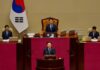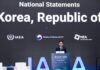

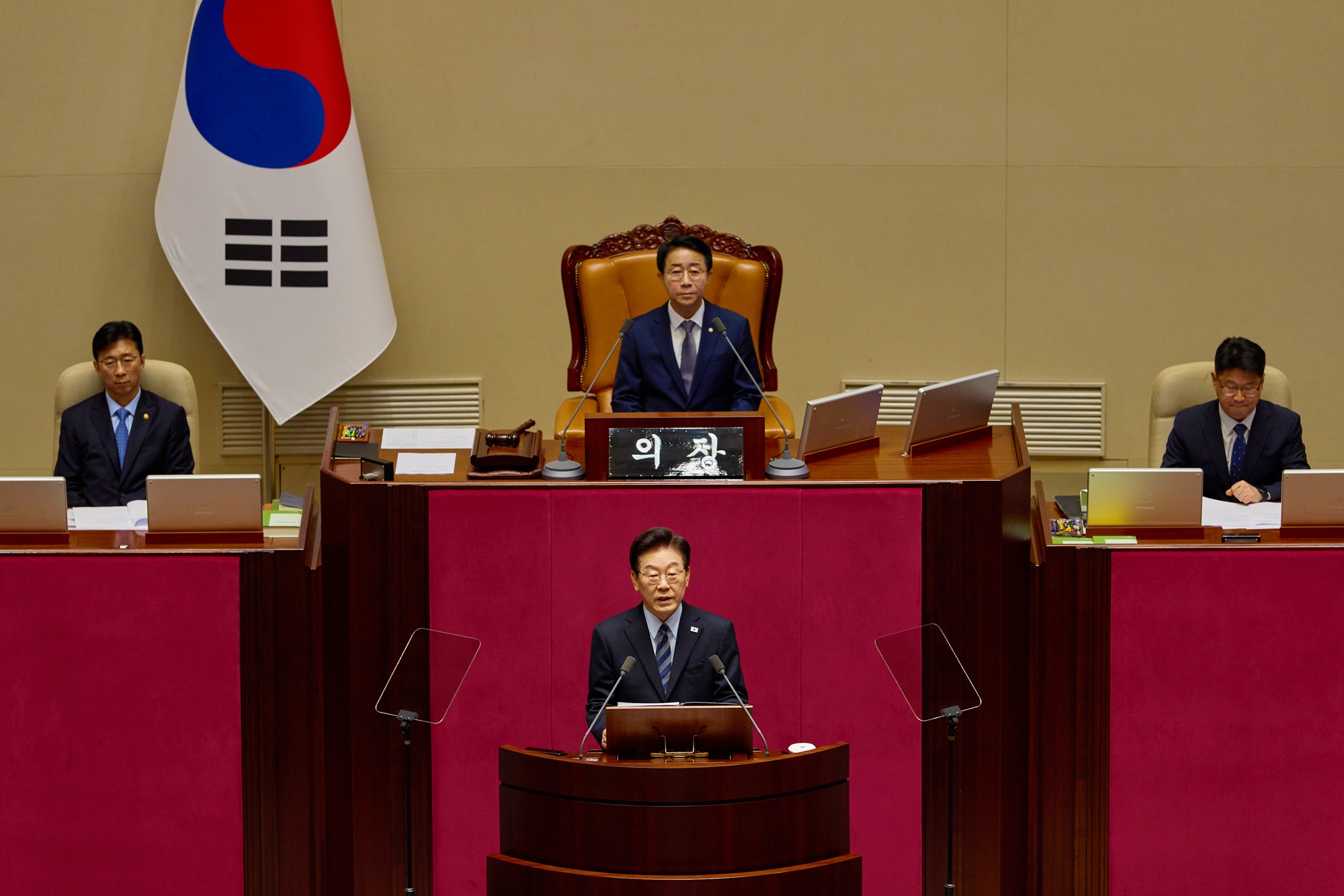
President Lee Jae Myung on Nov. 2 delivers a speech on the 2027 budget bill at the National Assembly in Seoul’s Yeongdeungpo-gu District. (Cheong Wa Dae)
By Xu Aiying
President Lee Jae Myung has urged a major shift from “growth for the few,” in which the opportunities and benefits of growth are concentrated in certain regions, social groups and a small number of companies, to “growth for all,” in which every region and its residents can share equally in such opportunities and benefits.
He said this on Nov. 2 in a policy speech on the 2027 budget bill at the National Assembly in Seoul’s Yeongdeungpo-gu District, outlining the direction of the proposed figure of KRW 820.9 trillion, up 12.8% from this year.
The president described the proposed budget as an investment in securing the country’s future, making Korea an irreplaceable global leader and spreading the benefits of national growth so that it translates into prosperity for the public.
His three principles for devising the budget were bold investment while eliminating wasteful and inefficient spending, priority on direct fiscal spending over tax expenditures and preferential support to the provinces outside the Seoul metropolitan area for balanced national development.
To this end, his administration reviewed all fiscal spending from the ground up, abolishing some 2,100 programs and restructuring 6,476 others for a combined expenditure adjustment worth KRW 107.2 trillion. Another 17 tax expenditure items including tax credits for marriage and childbirth worth KRW 1.9 trillion, were converted into direct fiscal support to extend benefits to more people.
The number of programs for greater support to regions farther from the capital was also increased to 61.
President Lee designated the reduction of social disparity as the top priority of next year’s budget. The standard median income, the benchmark for deciding eligibility for some 60 welfare programs, will rise 6.7%.
Support for small business owners and the self-employed will be expanded, while the budget for youth initiatives will jump 53.5% to KRW 43.3 trillion.
A budget of KRW 33 trillion, more than double this year’s figure, will help transform national territory and spur region-led growth, with a strategic shift toward decentralizing administrative functions to local governments. Another program will seek to improve living conditions in the provinces like education, healthcare and social welfare.
The second priority was securing future growth engines, for which KRW 21.3 trillion will go into artificial intelligence (AI) and the nation’s three megaprojects of semiconductors, physical AI and AI data centers. Another KRW 13.8 trillion will help develop 10 next-generation strategic technologies that are expected to follow chips.
The research and development budget of KRW 39.5 trillion will target seven key areas of future-oriented technologies like the seven SEED (Strategic Emerging Engines for Disruptive Innovation) sectors.
Investment in national security, public safety and peace will also increase. The 2027 defense budget of KRW 73.3 trillion will seek to secure key military capabilities including those needed for the restoration of wartime operational control from the U.S., nuclear-powered submarines and KF-21 fighter jets, as well as development of manned-unmanned integrated forces based on AI, robotics and drones.
President Lee concluded his speech by stressing implementation and speed as key factors, urging the legislature’s cooperation to get the budget proposal and related bills finalized by the statutory deadline of Dec. 2.
xuaiy@korea.kr