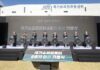

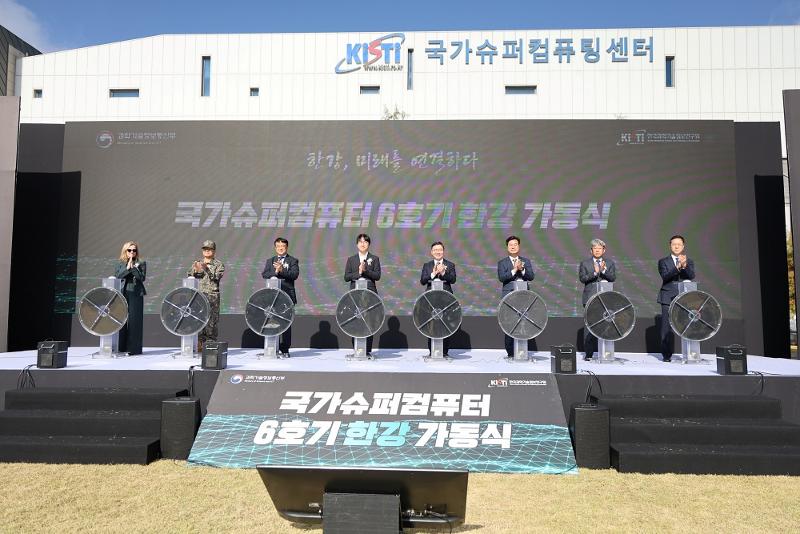
Attendees on Nov. 2 applaud at the launch ceremony for the sixth national supercomputer Hangang at the Korea Institute of Science and Technology Information (KISTI) in Daejeon. (KISTI)
By Lee Jihae
Hangang, the nation’s sixth-generation national supercomputer, is expected to strengthen the country’s research capabilities in artificial intelligence (AI).
The Ministry of Science and ICT and the Korea Institute of Science and Technology Information (KISTI) on Nov. 2 said they held a launch ceremony for Hangang at KISTI headquarters in Daejeon. About 200 representatives from industry, academia, research institutes and related organizations attended.
A supercomputer has a high-performance computing system that processes and analyzes massive amounts of data at ultra-high speed. Since launching its first in 1988, Korea has built five such machines.
Developed as the successor to the fifth-generation Nurion, which debuted in 2018, Hangang can support both traditional central processing unit (CPU)-based computational science and simulation research and AI-driven research using the latest graphics processing units (GPU).
Hangang has 8,496 state-of-the-art GPUs — including Nvidia’s GH200 — and 9,936 CPUs. Its theoretical computational performance of 614 petaflops is 24 times faster than Nurion’s, with storage capacity multiplying 10-fold to 205 petabytes and network performance quadrupling.
The plan is to use Hangang to support national strategic research and development initiatives such as K-Moonshot, a project that aims to double research productivity by 2030 and achieve 12 national missions in eight strategic fields by 2035, as well as provide backing for research by universities and public think tanks and technological advancement by companies.
KISTI President Lee Sik said his institute will actively support researchers through stable system operations and user assistance.
jihlee08@korea.kr