
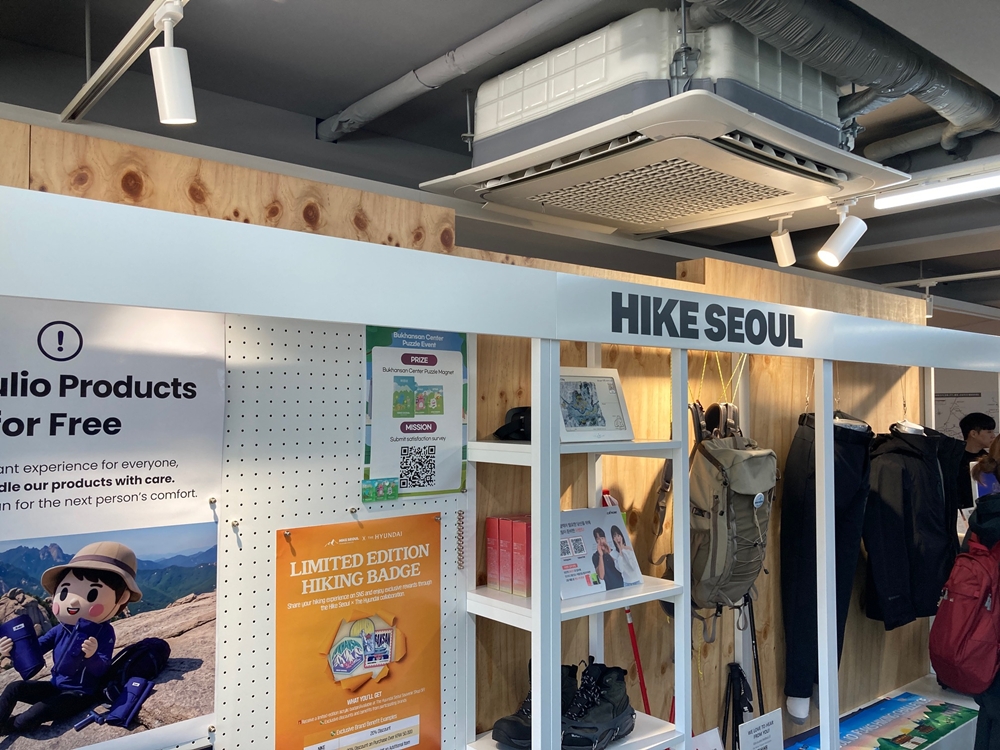
Hiking gear at Seoul Hiking Tourism Center’s branch on Bukhansan Mountain
By Jeong Euiseok
Photos = Jeong Euiseok
More foreign tourists are exploring the mountains of Seoul.
The Seoul AI Foundation in July released data on foreign visitor flow from last year showing the rising popularity of such mountains Bukhansan, Bugaksan and Gwanaksan among international visitors to the capital. Bukhansan attracted the highest daily number of foreign visitors with an average of 4,015, followed by Bugaksan with 2,169 and Gwanaksan 1,192.
The Ministry of Climate, Energy and Environment and the Korea National Park Service on Oct. 23 hosted a media tour of Bukhansan, offering participants the opportunity to experience the mountain’s nature colored with autumn foliage while learning the ecological value of Bukhansan National Park.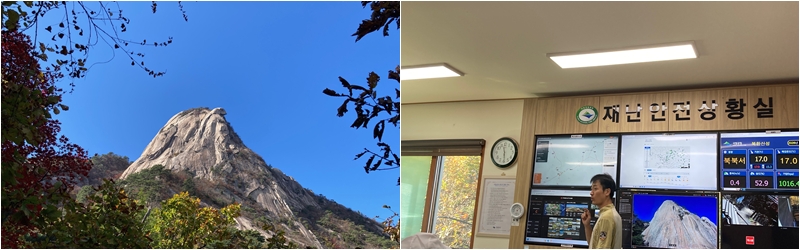
On the left is a view of Insubong Peak and on the right is Lee Seung Ik, a section chief of the safety management division of the Korea National Park Service, explaining the AI-based system of Bukhansan National Park.
On the morning of Oct. 23, the first stop by car was the Seoul Hiking Tourism Center’s Bukhansan branch, which provides hiking guides, information brochures, and hiking rental equipment like apparel, trekking poles and boots.
Around 10:20 a.m. after some light stretching, the hike began toward the destination of Baegundae, the highest peak of Bukhansan, at 836 m above sea level. The fall weather was clear and crisp and the vibrant red foliage stood out.
Upon reaching Harujae Pass, a small rest area, Insubong Peak, which rises 811 m above sea level, came into view. Its towering sculptural silhouette enhanced the mountain’s stunning scenery even from a distance.
The group stopped at the office of the special mountain rescue team to learn about the park’s artificial intelligence (AI)-powered safety systems. An AI-based framework to prevent wildfires detects smoke, instantly marks the location with a red square and automatically sends a text message to the person in charge to confirm if a fire occurred.
An AI-based weather forecasting model was developed to respond to challenges posed by climate change like torrential downpours and sudden temperature fluctuations. Internet of Things sensors installed throughout the park collect temperature and humidity data for cross-referencing with information from the Korea Meteorological Administration to for forecasts.
Behind every safe hiking experience are professionals working quietly behind the scenes.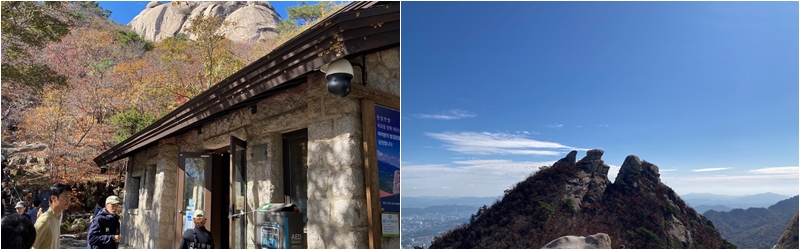
Baegunsan Mountain Lodge (left), located about 650 m above sea level, bustles with visitors even on weekdays. On the left is the southern peak of Mangyeongdae in a photo taken from the rocky ridge section on the path leading to the summit.
After a short break, the hike resumed toward the summit. Some said the trail was not that hard but it turned out tougher than expected. The many rocky sections made the trek increasingly tiring, while the seemingly endless flights of stairs made it difficult to catch one’s breath.
The group, after what felt like an endless climb, finally reached Baegunsan Mountain Lodge, nestled at an elevation of about 650 m. Since opening in 1924, the facility for decades has offered a resting place for hikers, bustling with visitors even on a weekday
The many foreign hikers spotted on the trail punctuated the growing global popularity of exploring Korea’s mountains.
At noon, the hikers sat on a bench in front of the lodge and ate gimbap (seaweed rice rolls) given earlier in the final stop before reaching the summit. With Baegundae Peak drawing closer, a sense of nervousness and anticipation began to build.
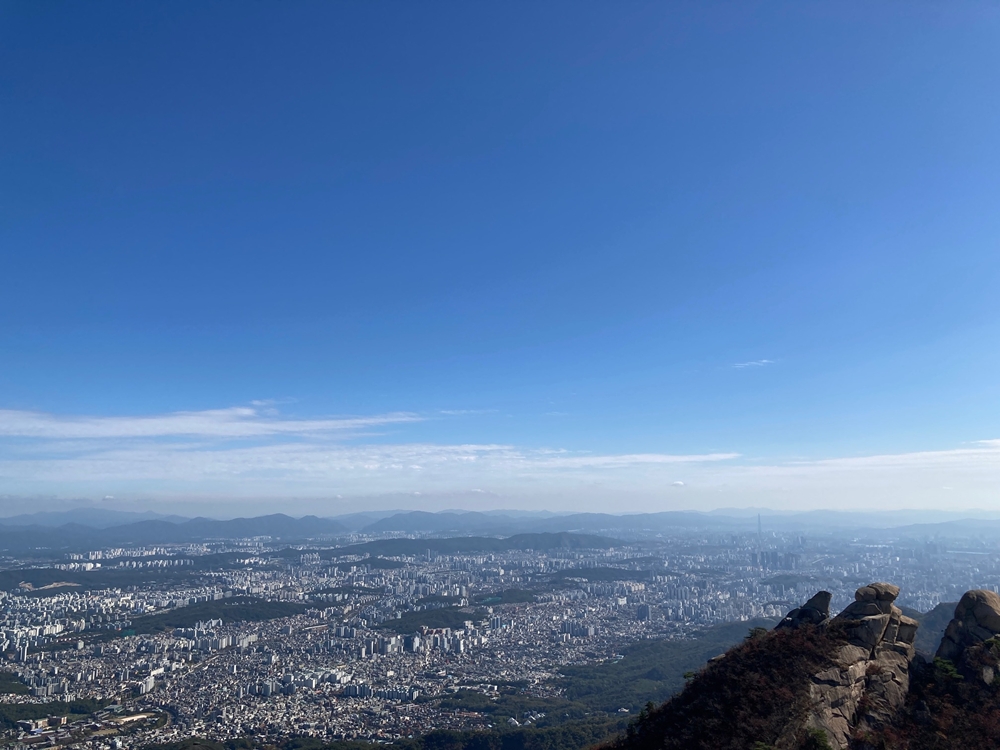
View of Seoul from close to Bukhansan’s summit
The summit was just 500 m away, but the most challenging part of the hike lay ahead: a steep and rocky ridge. After climbing the stairs near the lodge and following the fortress wall, the ridge and metal safety railings came into view.
The ridge leading to Baegundae was quite steep and seemed difficult to climb without proper hiking gear. The group took about 20 minutes to carefully ascend with the help of metal safety railings, after which the peak of Baegundae was finally within reach.
From a rock near the summit, a sweeping panoramic view of Seoul unfolded below. The breathtaking sight seemed to dissipate the fatigue and tension of the climb in an instant.
Yet the long line of hikers waiting to take photos at the summit meant turning back just short of the peak. Still, the spectacular view of the cityscape alone made the challenging hike worthwhile.
Hiking in the heart of the capital under a clear fall sky immersed in nature offered a refreshing escape from the daily grind. For those seeking a quick weekend getaway, Bukhansan offers that through the tranquility of nature.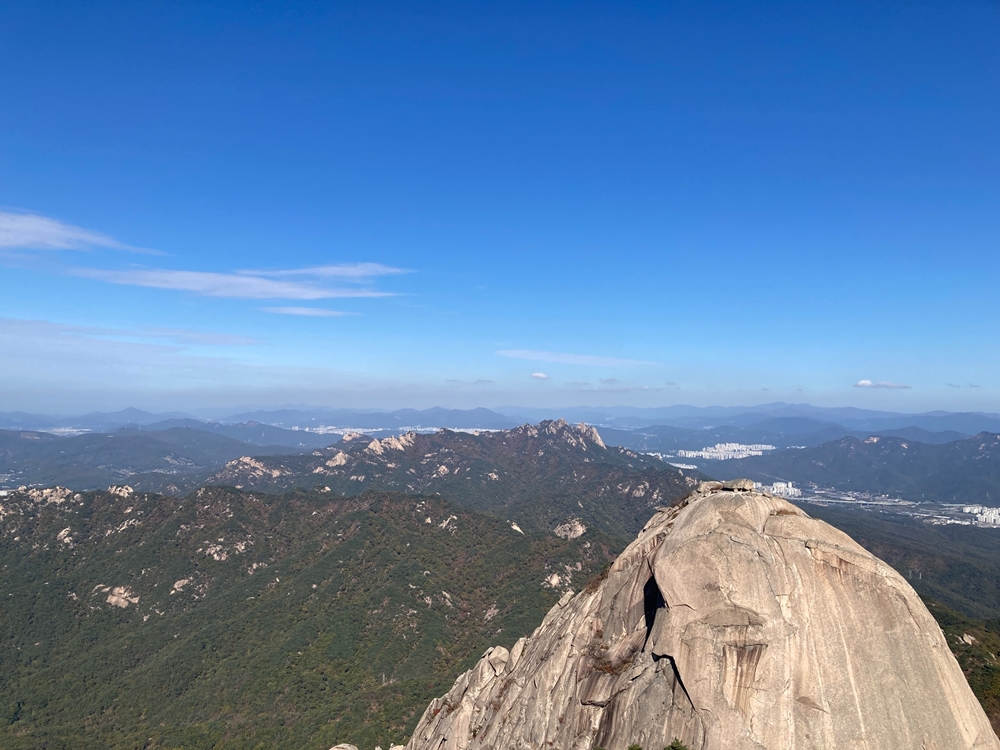
This view of mountains near the summit of Bukhansan Mountain shows the rocky peak Insubong directly ahead.
innocence@korea.kr