
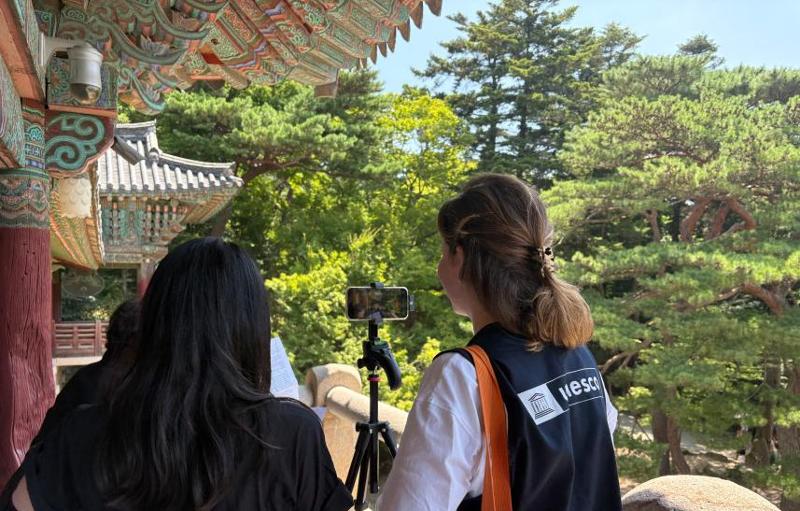
The Korea segment of the fourth season of UNESCO’s World Heritage Series through Dec. 22 will be released sequentially through UNESCO’s official social media channels including Instagram and YouTube. Shown is a UNESCO production team filming part of the series’ Bulguksa Temple episode in Gyeongju, Gyeongsangbuk-do Province. (Korea Heritage Service)
By Yoon Sojung
UNESCO will use its social media channels to promote Korea’s tangible and intangible cultural heritage to the world.
The Korea Heritage Service (KHS) on Nov 25. said the UNESCO video series “Korea: A Journey through Time,” which was produced in collaboration with the International Centre for the Interpretation and Presentation of World Heritage Sites (WHIPIC), runs through Dec. 22 on UNESCO’s official social media in the fourth season of UNESCO’s World Heritage Series.
Launched by UNESCO headquarters in 2024, the series is a digital campaign featuring short-form videos to highlight the outstanding universal value of World Heritage sites and the importance of their preservation. Previous seasons have covered places like the banks of the Seine River in Paris, India’s Golden Triangle, a tourist circuit in the country’s northern region connecting Delhi, Agra, and Jaipur, and the works of Spanish architect and designer Antoni Gaudi in Barcelona.
The Korea edition of the series was filmed in conjunction with the 48th session of the World Heritage Committee in July hosted by Busan.
A UNESCO filming team from July 28 through Aug. 2 visited World Heritage sites in Korea including the Petroglyphs along Bangucheon Stream in Ulsan; Seokguram Grotto and Bulguksa Temple in Gyeongju, Gyeongsangbuk-do Province; Janggyeong Panjeon, the depository of the Buddhist woodblocks Tripitaka Koreana at Haeinsa Temple in Hapcheon-gun County, Gyeongsangnam-do Province; Hahoe Folk Village in Andong, Gyeongsangnam-do, and Yangdong Folk Village in Gyeongju; Changdeokgung Palace in Seoul; and Beopjusa Temple in Boeun-gun County, Chungcheongbuk-do Province.
This also included three Korean items on UNESCO’s Representative List of the Intangible Cultural Heritage of Humanity: talchum (traditional mask dance), kimjang (kimchi making and sharing) culture, and production of jang (fermented sauces and pastes).
The series vividly captures each heritage site and presents stories of experts dedicated to their preservation and practitioners carrying on such traditions.
A behind-the-scenes episode will also be released. Footage separately recorded of filming by the UNESCO production team in the last week of November will be presented from an observer’s perspective on the Instagram and YouTube channels of WHIPIC.
The KHS said it hopes people worldwide will discover the nation’s diverse heritage and the stories of those protecting and passing it on, and that the series fosters a deeper appreciation for the value of such relics and the importance of their preservation and transmission.
arete@korea.kr