
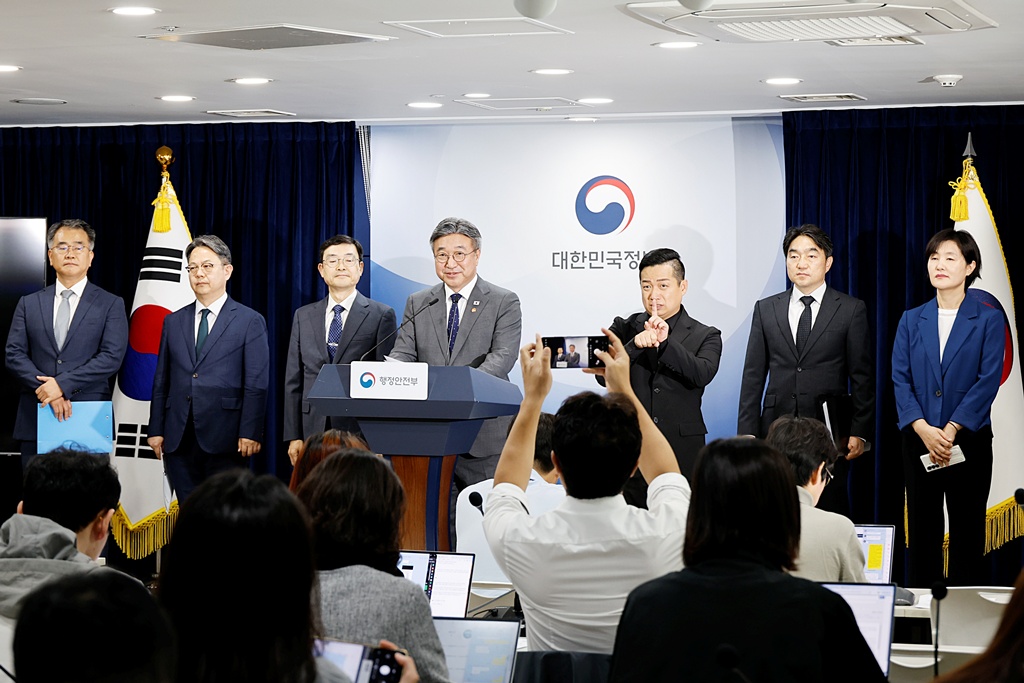
Minister of the Interior and Safety Yun Ho Jung (fourth from left) on the afternoon of Oct. 13 gives a briefing on the second phase of the relocation of central government agencies at Government Complex-Seoul in the capital’s Jongno-gu District. (Ministry of the Interior and Safety)
By Aisylu Akhmetzianova
From next year, 44 central government agencies including the Ministry of Foreign Affairs, Ministry of Gender Equality and Family, Ministry of Unification, Ministry of National Defense and Ministry of Justice will relocate to Sejong, bringing 9,929 civil servants with them.
The Ministry of the Interior and Safety on Oct. 13 announced the plan to gradually move the organizations from next year out of the Seoul metropolitan area to Sejong to boost the national governance system centered on Sejong.
The second phase was announced on Sept. 3. The list of agencies to be relocated and methods were finalized through consultations with relevant agencies.
First, 27 institutions with a combined 2,995 employees that do not require their own office buildings are expected to finish relocation by next year, using privately leased spaces in Sejong.
Seventeen agencies with a combined staff of 6,934 require their own buildings and specialized facilities for functions such as investigation, security, and control. These entities will move sequentially after new buildings are completed by 2031.
Support measures undergoing preparation include moving costs, initial relocation assistance and transportation subsidies to help civil servants and their families settle in Sejong.
Minister of the Interior and Safety Yun Ho Jung said, “The relocation of central government agencies to Sejong is a pivotal national strategy for the Republic of Korea to overcome the Seoul-centric system, efficiently use national territory, and achieve sustainable growth and a new leap forward.”
aisylu@korea.kr